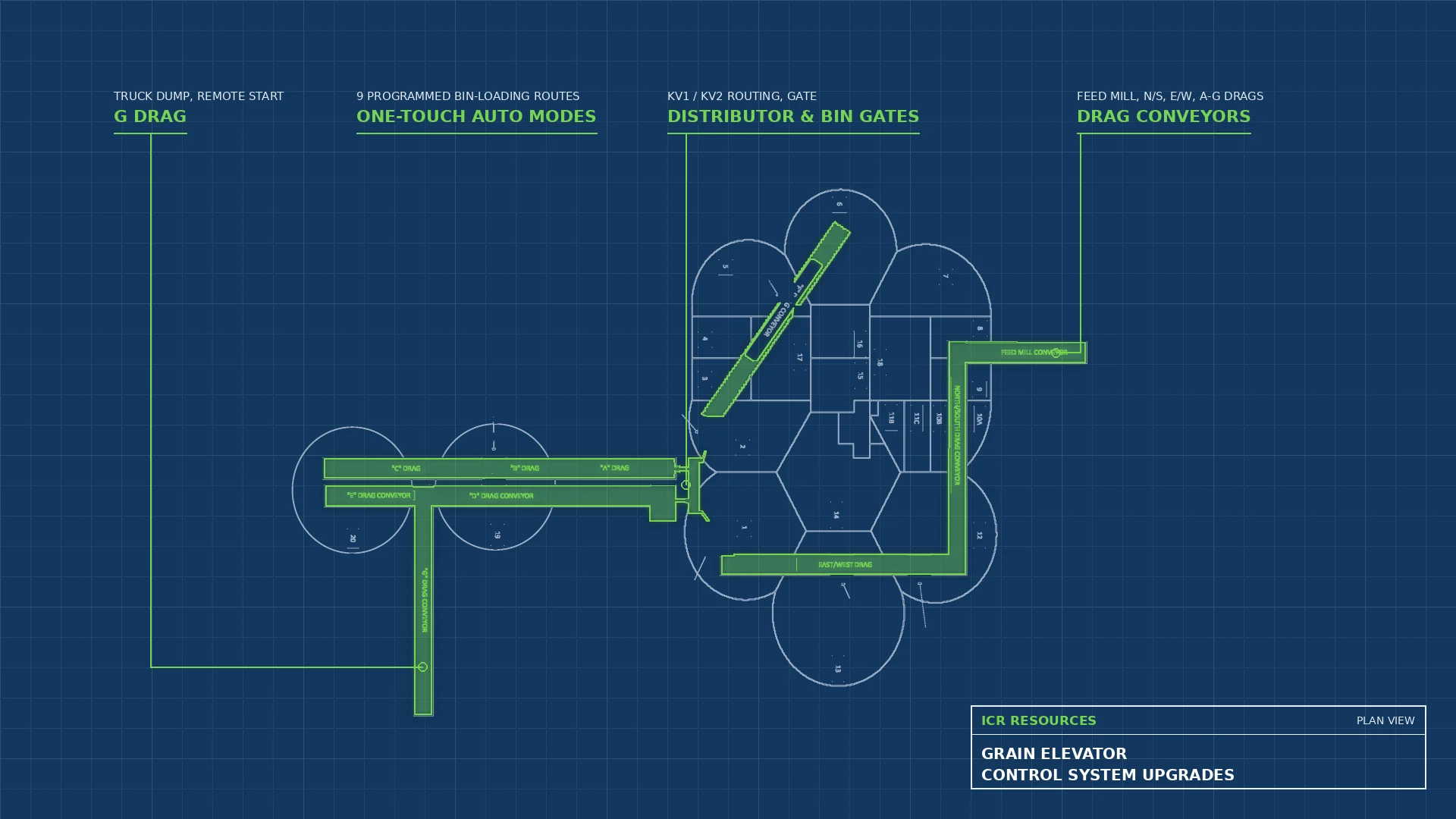
A grain elevator control system was left with an incomplete integration. The PLC program did not match how the facility actually ran, outputs were wired to relays that controlled nothing, current switches and gate limit switches were partly or never wired, and documentation was hand-written notes taped inside panel doors. Operators could not count on the system to route grain from the dryer leg and main elevator to the right bins, conveyors and feed mill.
Key Requirements
Assess the existing program and wiring
Document a theory of operation with the owner
New PLC and touch-screen programs to match
Rewire MCC and field cabinet controls
Add remote I/O and missing gate and motor feedback
Install, test and hand over documented system
The ICR Solution
ICR started by assessing the existing program and tracing every field wire, then wrote a theory of operation with the owner covering nine automatic loading routes: Bins 1, 2, 5, 6, 12, 13, 19 and 20 plus the feed mill. ICR developed a new Allen-Bradley CompactLogix PLC program and touch-screen interface to match, prompting operators to set each distributor, confirming bin gates open or closed, and starting the drag conveyors and legs in the right order. In the MCC and outdoor cabinet, ICR rebuilt the control wiring, added remote I/O, brought gate limit switches and conveyor current switches into the PLC, removed dead circuits and re-mapped and labeled every point.
Equipment & Technology
Allen-Bradley CompactLogix 1769-L27ERM PLC
Remote I/O in the outdoor field cabinet
Touch-screen HMI with overview, bin selection, maintenance and alarm screens
Conveyor current switches for run confirmation
Bin gate open/close limit switches
Distributor valve control (top and bottom valves)
Remote start for outside truck dump drag
Scope of Work
System Assessment
Theory of Operation
PLC Programming
HMI Programming
MCC & Field Rewiring
Remote I/O Addition
I/O Mapping & Documentation
Installation & Testing
Results
The elevator now runs on a control system that matches how it actually works. Operators pick a route on the touch screen, set the distributor when prompted, and the system confirms gates and starts conveyors in sequence, with current switches proving each drag is running. Dead wiring is gone, every point is mapped and labeled, and the owner has a written theory of operation and current drawings for the first time.