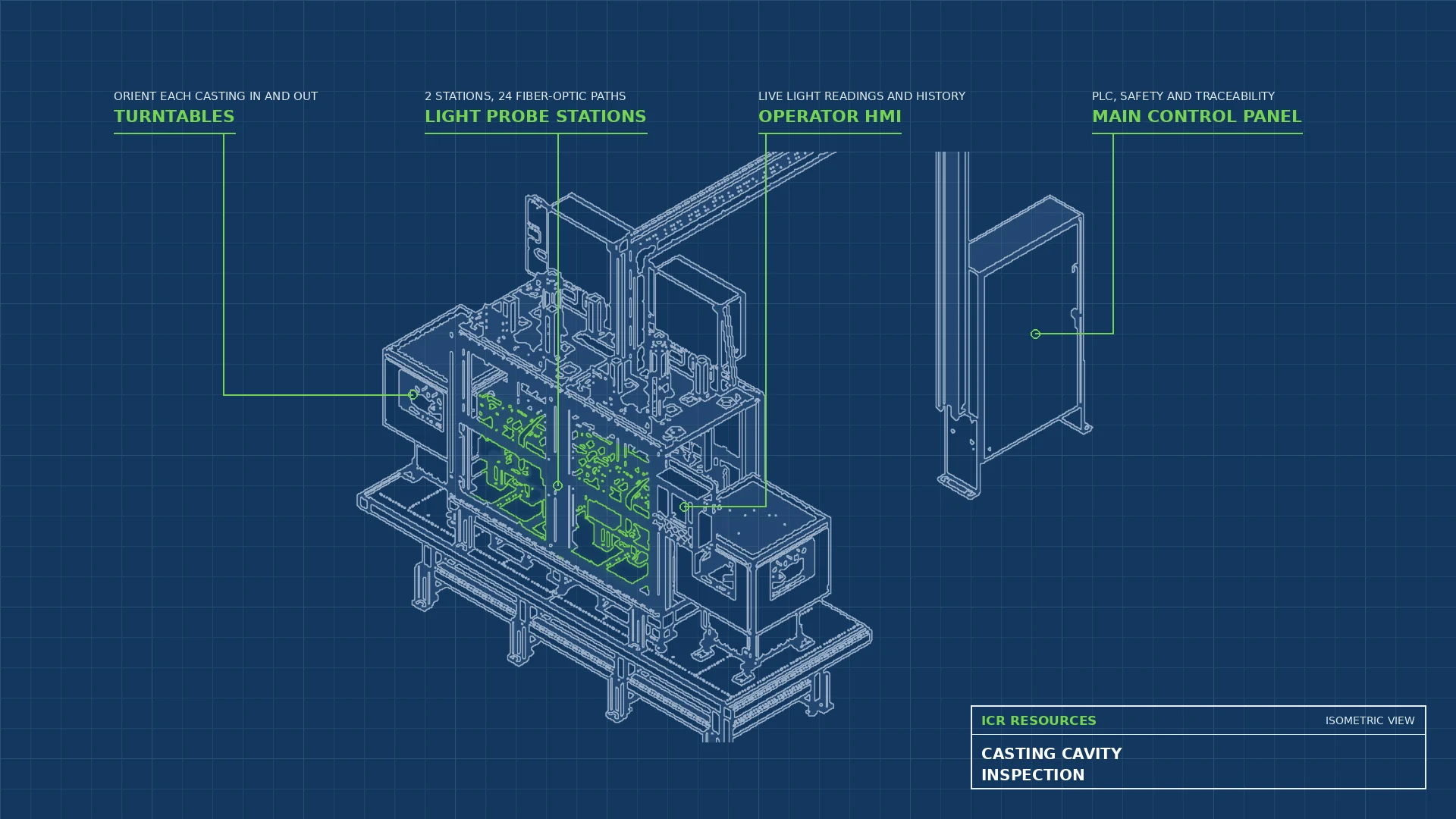
A casting line needed proof that every part’s internal cavities and ports were open. A broken core or leftover sand can block a passage that no one can see from the outside, and a blocked port that reaches machining or assembly becomes scrap, rework or a field failure. Manual checks could not keep pace with the line or cover every passage. The customer needed automatic casting cavity inspection that fit into an existing line between turntables, a re-entry conveyor and a reject conveyor, and that tied each result to the casting’s code.
Key Requirements
Verify that critical internal cavities and ports are open on every casting
Inspect in line at production rate
Turntables, reject conveyor and re-entry conveyor included
Protect probes from contact with core breaks or leftover sand
Read each casting’s code and store its results
Support multiple part variants
Guarded, interlocked machine with lockout points
The ICR Solution
ICR designed and built a two-station casting cavity inspection machine around Keyence fiber-optic sensing. Each casting is located on datum pins and locator pins, then the probe platens lower. Thru-beam light probes enter the casting from above and the sides, and light must pass from emitter to receiver through each passage. 24 fiber amplifiers send their actual light readings to the PLC, which compares them to thresholds instead of trusting a simple OK/NG output. Vertical probes are spring loaded and horizontal probes advance on low-pressure air, so a blocked passage cannot damage them. Turntables orient castings in and out, a reject conveyor diverts any blocked part, and a re-entry conveyor returns parts to the line. A code reader ties every reading to the casting.
Equipment & Technology
2 inspection stations with probe platens and lifters
24 Keyence fiber amplifiers with thru-beam fiber probes
Datum and locator pins for repeatable part position
Keyence 2D code reader for traceability
Laser sensors for added feature checks
PLC with HMI, measurement history and counters
Interlocked doors, E-stop and safety relay
Two turntables, reject and re-entry conveyors
Movable access deck
Scope of Work
Up-Front Engineering
Mechanical Design
Fabrication
Controls Design
Panel Build
PLC & HMI Programming
Traceability
Installation
Commissioning
Results
Every casting now has its internal cavities and ports checked in line, with all 24 light readings stored against its code. Blocked passages are caught at the source and routed to the reject conveyor instead of reaching machining. A master casting lets the team confirm light levels at any time, and the probe design keeps a blocked part from damaging the machine.