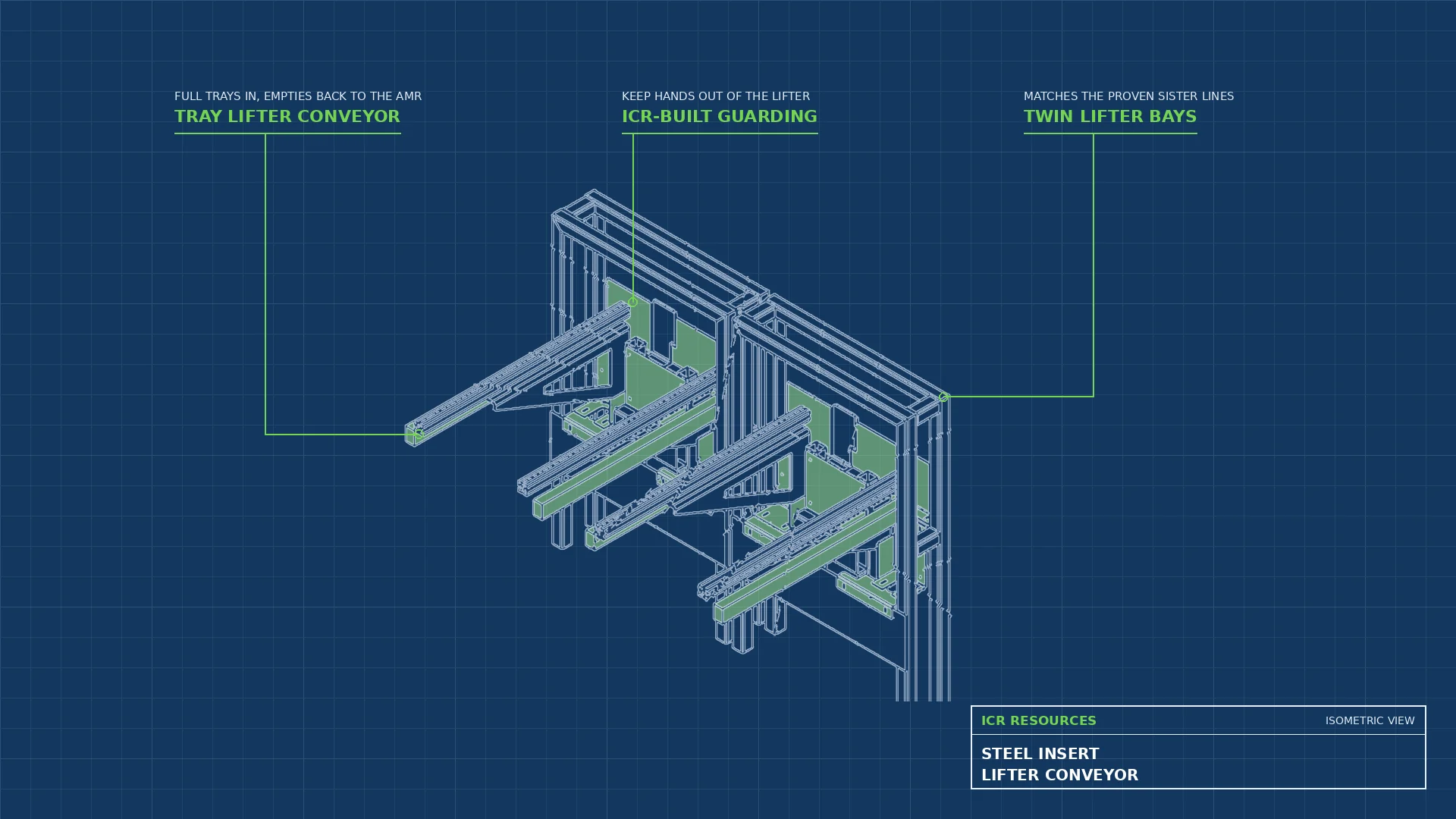
A casting line needed to receive steel insert trays directly from an autonomous mobile robot (AMR), the same way its sister lines already did. The existing conveyance sat outside the robot fence and blocked the AMR’s path, and any new transfer point would put a lifter and pneumatic actuators right where team members load and clear trays. The customer needed a proven lifter design that fit the existing conveyance and controls, kept actuators at Category 3, and made it impossible to reach into a moving machine.
Key Requirements
Receive full trays from an AMR and return empty trays
Clear the AMR path by removing old conveyance
Match the proven lifter design on the sister lines
Category 3 safety on lifter and pneumatic actuators
Guard every reach-in point around the lifter
Confirm the AMR is docked and aligned before transfer
Run from the existing robot cell controls
The ICR Solution
ICR removed the old conveyance outside the robot fence to open a clean AMR path, then designed and built a twin-bay lifter conveyor based on the proven systems already running on the sister lines. The AMR docks against an alignment rail, and a Keyence non-contact safety switch confirms it is in place before the lifter moves. Full trays transfer in and empty trays return to the AMR. Inner, outer and lower safety light curtains and ICR-fabricated guard panels surround the lifter, so no one can reach into active motion, and the actuators run on a Category 3 safety circuit. A new control system and remote panel tie into the existing unload-robot cabinet and its safety I/O.
Equipment & Technology
Twin-bay pneumatic tray lifter conveyor
Keyence GS non-contact safety switch (AMR docked)
AMR alignment rail
Inner, outer and lower safety light curtains
ICR-fabricated guard panels (8 designs)
Remote operator panel
Safety I/O via the existing robot cell controller
Scope of Work
Up-Front Engineering
Removal of Existing Conveyance
Mechanical Design
Fabrication
Controls Design
Safety Circuit Design
Remote Panel Build
PLC Programming
Commissioning
Results
The line now takes steel insert trays straight from the AMR with no manual handling, matching its sister lines. Every actuator runs on a Category 3 circuit, transfers only happen with the AMR confirmed in place, and light curtains plus guarding keep team members’ hands out of active motion. Building on a proven design and the existing controls kept the project fast and predictable.