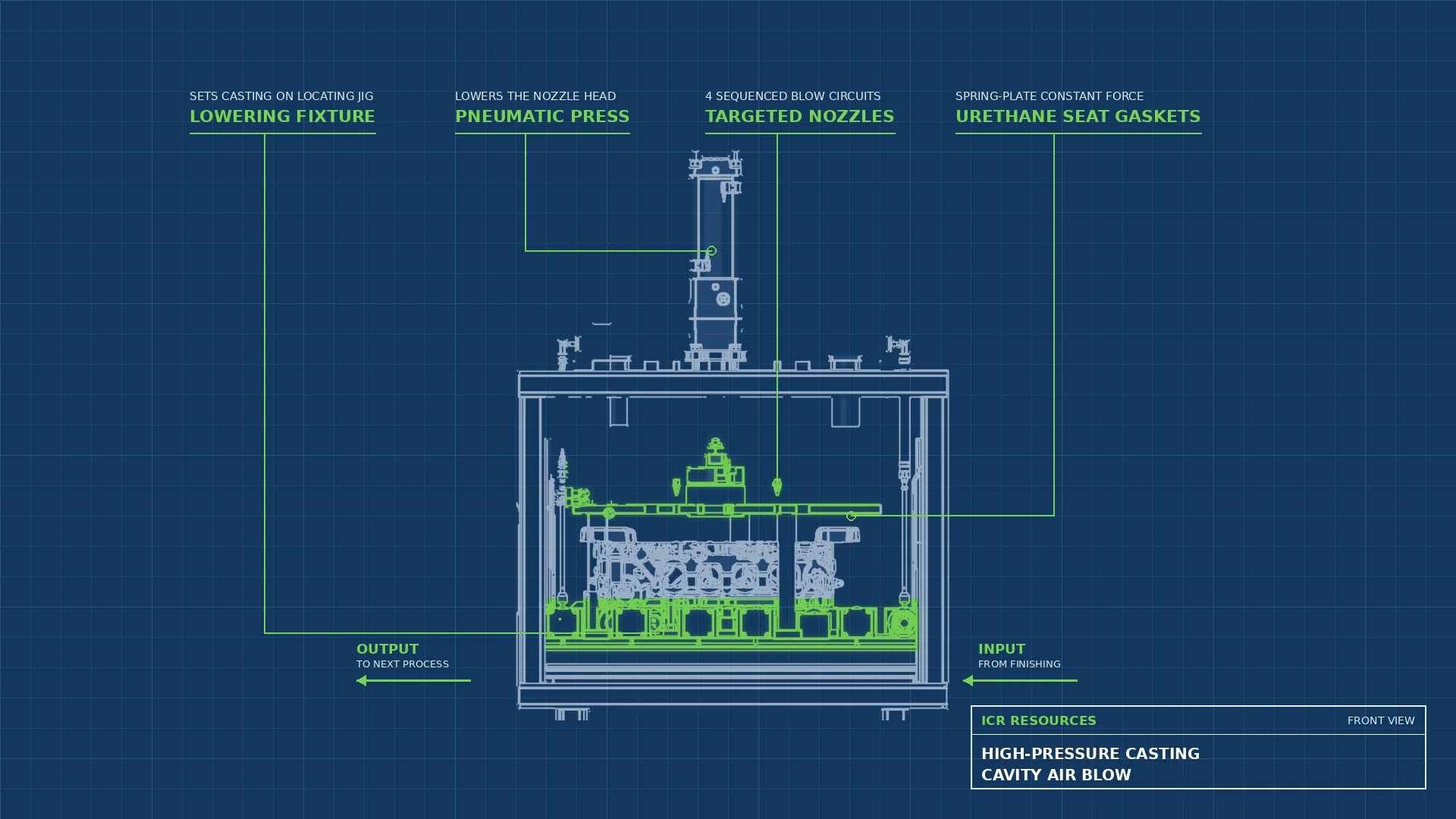
Castings leaving finishing still carried core sand and debris deep in their internal passages, where random or manual blow-off could not reliably reach. Sand left in a passage becomes a quality problem downstream, so the plant needed a machine that would clear specific passages with extreme force and repeatable precision, load and unload itself, and keep pace with the line.
Key Requirements
27-second cycle time
Precise casting location on a fixed jig
High-pressure, high-volume air delivered to specific casting passages
Precise, repeatable nozzle seating: same location and force every cycle
4 independently timed blow circuits fired in sequence
Verified air flow and supply pressure on every cycle
Automated input and output conveyor sections
Guarded doors, light curtain and lockable air shutoffs
The ICR Solution
ICR designed and built a custom high-pressure casting cavity air blow-off cell. An automated input conveyor carries each casting in, a stopper halts it under the blow head and a lowering fixture sets it onto a locating jig for precise casting position. A pneumatic press lowers a floating nozzle plate onto the part, where urethane gaskets seat each nozzle on its target passage. A wishbone-style spring plate holds the gaskets under constant tension, so every seat lands in the same location with the same predictable force. Four high-flow circuits, fed by a 1-inch supply through large-bore SMC valves, then fire in a programmed sequence, with each circuit’s timing set from the HMI. Digital flow switches confirm every circuit delivered air and a pressure switch confirms supply, so a weak blow is caught as a fault. The head lifts and the output conveyor carries the casting out on a 27-second cycle.
Equipment & Technology
PLC with discrete I/O
Touchscreen HMI with per-circuit blow timing
SMC VG342 high-flow valves on a 1-inch supply (4 circuits)
Urethane nozzle seating gaskets on a wishbone-style spring plate
Every casting gets the same targeted, high-force blow on every cycle, 24/7, clearing sand and debris from passages that random blow-off missed. Flow and pressure verification catches a weak or blocked circuit immediately instead of shipping a contaminated part, and automated in and out conveyors hold the 27-second cycle without operator handling, with high operational availability (OA) in high-volume automotive production.